

THE TYPO
I saw an article in The Wall Street Journal about people who write for a living. Something strange was happening across all of them. A copywriter has started dropping in phrases like “hey yo, for real” and stacking up exclamation points, on purpose, because sounding polished now reads as sounding synthetic. They say it feels icky. They do it anyway. A blogger litters his posts with references no AI would think to reach for, obscure lines from The Office, because a machine will not naturally go there and he needs proof that he did. A financial coordinator leaves an accidental typo in when he edits. A tech founder has started replacing his em dashes with two small dashes instead, and calls the habit his artisanal craftsmanship. None of these people are bad writers. They are good writers, deliberately damaging their own work, because a clean sentence has started to look like evidence against them.
Rest with that image for a moment before you make your claim about artificial intelligence. People are roughing up their own prose to prove a human being made it. The flaw has become the credential. The very credential a person spent years and thousands of dollars earning. And the typo, the exact thing your teacher’s red pen exists to destroy, has become evidence of humanity.
They are not alone, and they are not the only ones asking the questions underneath the questions. Somewhere a university president is trying to write a policy for an institution they lead, and they are not clear what they are protecting when they write it. An incoming freshman wonders whether it is cheating to ask AI to argue with their essay before they turn it in. A professor reads a paper smoother than anything that student has ever turned in and wonders, honestly, whose thinking they are grading. A novelist uses AI the way they used to use an editor, to ask where the middle sags. A copywriter watches a piece of their profession get automated and does not know whether to be afraid or relieved. A filmmaker looks at synthetic performers and generated backlots and wonders what is left of the craft they trained for. A pastor wonders, quietly, whether it betrays their calling to let a machine help them find a text before Sunday. A factory worker and a paralegal are afraid, rightfully so, that the thing paying their rent is about to be done by something that doesn’t need rent paid at all. Sam Altman and the handful of people like him keep building systems whose capability is outrunning the world’s ability to agree on what any of it means. And somewhere in the middle stands the person who has decided, simply, “I don’t use AI. It’s bad,” saying it the way you might say you don’t eat meat, as though refusal itself were the whole of the ethic.
Everyone in that list thinks they are having an argument about a technology. They are not. Before we can say a technology is immoral, we have to say what moral claim it has violated. Most of us skip that step. We go straight to the verdict. Good or bad. Cheating or not cheating. Real or fake. We have quietly started confusing where a thing came from with whether it is good. We have begun confusing provenance with virtue.
A wrong question, asked forcefully and repeatedly enough, can occupy a whole society for decades. The question is not, is AI good or bad? AI raises enormous questions about the environment, power, exploitation, and economic justice, and none of them should be dismissed. But they are not the question of this essay. Mine is narrower: what are we trying to preserve about the human being here?
IF THIS IS A MORAL CRISIS, LET US ACTUALLY DO MORAL REASONING
If artificial intelligence really is a moral crisis, and I believe some version of it is, then the honest move is not a slogan. It is not simply an emotional reaction. It is moral reasoning, the actual discipline of it.
While studying at Union Theological Seminary in New York, I learned about an old tradition in moral theology called casuistry, a method closely associated with the Jesuits. To be fair, it has a bad reputation it does not fully deserve. People hear the word and think excuse-making, splitting hairs until the sin disappears. That is a corruption of the method, not the method. Casuistry refuses to solve a hard question with a slogan. It looks at the particular case in front of you, because morality lives in particulars, not categories. If we are going to treat AI as a moral question, we owe it an actual moral process, not a posture.
The classical structure asks three things of any act. The object: what is actually being done? The intention: why is the person doing it? The circumstances: under what conditions is the act occurring? That framework gives us the method, but it was never designed with artificial intelligence in mind. For the case in front of us, I want to add three more questions. Covenant: what does this activity implicitly promise? Epistemic ownership: who actually possesses the understanding behind the act? Responsibility: who answers for the result?
Start with an easy case.
Spellcheck fixes a typo. Fine. AI fixes the same typo. Still fine, presumably. A human editor tells a writer that a paragraph is weak. Also fine, and expensive, if you can afford one. AI tells them the same thing. A human editor proposes a better sentence. AI proposes a better sentence. A writer with money pays a developmental editor thousands of dollars to interrogate a manuscript, argue with it, push it somewhere it was not going to go on its own. A writer without that money uses AI to get something like the same pressure applied to the same pages.
At exactly which step did the act become immoral, and why? I am not going to answer that yet. Sit in the discomfort of not being able to answer it quickly. If you cannot locate the exact rung where legitimate assistance turned into cheating, you do not actually have a clear moral objection to AI. You have a feeling about it, and feelings deserve honesty and interrogation, not the dignity of a verdict.
WHOSE THINKING IS THIS
We need to separate two things that AI has collapsed into one another in the public imagination: producing words and possessing knowledge.
There is a difference between epistemic authority, why anyone should trust that I know something, and epistemic ownership, whether I can actually claim the understanding as mine. Can you say: I understand this. I believe this. I can explain it. I can defend it. I can revise it when somebody pushes back. I accept responsibility if it turns out to be wrong. If you can say all of that, substantial epistemic ownership still belongs to you, even if AI was part of the room where the thinking happened.
The countercase: somebody asks AI to explain Kierkegaard, builds an argument on top of it, submits the argument, and cannot explain a word of it when a professor pushes back. The words bear their name. The knowledge does not. That is theft of a strange kind, a kind that robs the thief themselves.
The words can belong to you while the understanding does not. And the reverse is also true. An idea can genuinely become yours even though you did not generate every stimulus that produced it. Human beings have always thought in community. We think with teachers, editors, books, libraries, colleagues, parents, sermons we half remember, search engines, the whole slow accumulation we call culture. AI changes the power and proximity of that assistance. It does not change the fact that none of us has ever thought entirely alone. Nobody accuses a doctoral student of fraud because their committee shaped their thinking. We become much quicker to reach for that word when the community doing the shaping gets fast, cheap, and available to everyone at once.
So the question is not, did a machine touch this? The question is, did the machine extend the thinking I was already doing, or replace the thinking I was supposed to do myself? That question does more work than any blanket rule ever will, and it sets up the weakest argument on my own side of this debate, which deserves to be named honestly.
“AI IS JUST A TOOL” IS NOT GOOD ENOUGH
Somebody, in nearly every conversation about this, will eventually say: AI is just a tool. And they are right. Yet it tells us almost nothing.
Steroids are a tool. Running shoes are a tool. A calculator is a tool. Photoshop is a tool. A motorcycle is a tool. Calling something a tool does not tell us whether using it is right or wrong. Every one of those tools is perfectly acceptable in one setting and cheating in another.
A calculator in an accounting department is simply how the work gets done. The same calculator, used during an exam built to measure whether the student can do the math, defeats the whole purpose of the exam. A motorcycle to get to work is just transportation. A motorcycle ridden during a marathon is fraud, and everybody already knows it without needing a lecture. The machine did not change between those two cases. The covenant did.
Every activity carries an implicit agreement about what a human being is supposed to contribute to it: the covenant of the activity. Usually it is unwritten, and we only notice it exists the moment somebody breaks it.
That covenant tells us what is actually at stake when the tool enters the activity.
Not, is this tool good or bad? But what are we trying to preserve about the human being here?
THE WASHING MACHINE AND THE MARATHON
Nobody stands over a washing machine and says, your grandmother scrubbed those clothes by hand, and you pushed a button, and you cheated. The point of laundry was never the scrubbing. The point was clean clothes. The labor was only ever a means to that end, and when technology removes the labor and keeps the end, we call it progress.
But nobody accepts “I covered twenty-six point two miles” if the miles were covered on a motorcycle. Why? Because arriving was never the point of a marathon. The running is the point. The labor is not a means to the achievement. The labor is the achievement. Remove it, and there is nothing left to admire.
That difference gives us a taxonomy.
There is labor as means. The labor produces something we actually want, and the labor itself is not the point. Transcription. Formatting. Laundry. A great deal of calculation and research retrieval. Spellchecking. Most administrative work. Automating labor like this is not seen as a betrayal of anything. It’s often seen as mercy.
There is labor as performance. The activity itself is the thing being demonstrated, and automating it does not speed up an outcome. It erases the outcome entirely. A marathon. A chess match. A musical performance. Certain examinations. Automate these and you have not helped the human being. You have taken the thing away and left the trophy.
And there is labor as formation, the category that matters most here. Sometimes labor is not valuable primarily for what it produces. Doing the work produces a different human being than the one who started it. A student struggling through an argument becomes someone who can argue. A doctoral candidate learning research becomes a researcher, and the dissertation is almost a receipt for that becoming, not the point of it. A minister wrestling with a difficult text on a Tuesday night becomes a different kind of preacher by Sunday than he would have been if the wrestling had been outsourced. In each case the artifact, the essay, the dissertation, the sermon, is partly a byproduct. The formation is the actual product.
AI can produce the assignment while preventing the formation the assignment was designed to produce.
But that is only half the truth, and the other half complicates it immediately. AI can also challenge a student, interrogate their assumptions, demand they explain themselves, generate counterarguments they have to answer. Used that way, it increases formation instead of erasing it. AI use is not, by itself, cognitive surrender. It depends on what the human does with the tool, which is why the only honest governing question, in a classroom or a newsroom or a sanctuary, is this: what disappears from the human being when this labor disappears? Hold that question. We will need it again.
THE KITCHEN
Move now from the individual case to historical memory, because we have been here before, more than once, and forgotten it every time.
Technology has repeatedly renegotiated who does labor and what that labor means, nowhere more than in the kitchen.
Affluent households had been outsourcing domestic labor to lower-status human beings long before modern appliances transformed the kitchen. That is the covenant that existed before the technology showed up, and it is worth saying plainly, because the nostalgia people feel for how things used to be done is very often nostalgia for somebody else doing it.
Then a convergence of forces, new employment opportunities for women, industrialization, suburbanization, packaged foods, the automobile, the whole reorganization of household life, transformed domestic labor. And the machines came with it. The washing machine. The dishwasher. The refrigerator. Prepared foods. Fast food. The microwave.
Nobody today opens a microwave and thinks, I am participating in a centuries-long renegotiation of who performs domestic labor. They think: dinner. That forgetting is not an accident. It is what happens to every disruption that succeeds. Yesterday’s moral and economic upheaval becomes tomorrow’s infrastructure. Eventually we forget there was ever another covenant governing this activity at all.
Convenience is often society’s polite word for labor we have collectively granted ourselves permission to eliminate. Washing your clothes by machine is not called automation. It is called convenience. Buying prepared food is not called outsourcing your labor to a corporation. It is called convenience. The word does real work. It lets disruption happen without anyone holding a funeral for what it replaced. It lets us forget the labor, and often the laborer.
Which forms of cognitive labor that we currently regard as essential to human identity will later generations simply call convenience?
But do not let that question tip you into celebrating every disruption on principle. Cognition is not laundry. Some cognitive labor forms us. Some establishes competence. Some establishes the authority to speak on a subject at all. Some creates relationship, the kind that only exists because two people struggled through something together. Some carries moral responsibility that cannot be transferred to anyone else. Some may simply consume time we would rather have back. We need to know which is which before convenience makes the distinction invisible, the way it already has with the microwave.
WHAT COPYRIGHT ALREADY KNEW
There is an assumption underneath a lot of the anxiety about AI, and it needs to be tested before we go any further. The assumption is that whoever performs the labor necessarily owns and authors the result. Copyright law and corporate life have long made things more complicated than that.
Take an ordinary case from advertising, one that has nothing to do with AI at all. A junior copywriter produces twenty concepts. A creative director selects one and rewrites half of it. The agency presents it to the client as though it emerged fully formed. The client pays. The corporation may ultimately own the resulting intellectual property through work-for-hire rules or contractual assignment.
Labor: who performed the work. Judgment: who decided what was good. Epistemic ownership: who actually understands the thing well enough to defend it. Authorship: who is socially or legally recognized as its author. Ownership: who holds the legal and economic rights. Responsibility: who answers for it if it fails or gets the company sued. In that copywriter’s case, those may be six different people. They have never necessarily been the same person. AI did not invent their separation. AI exposed a separation that copyright law and corporate life had already normalized long before artificial intelligence arrived.
And AI occupies a strange new position inside that old separation. Our institutions have long wrestled with the fact that the person who performs the labor, the person who gets the credit, the person who owns the result, and the person who answers for it are not always the same person. AI does not create that problem. It complicates it. Now a system can perform work that once required human labor without itself becoming an author, an owner, a wage earner, or the person responsible for what it produces.
If a copywriter is displaced by a system that can generate twenty concepts in the time it took them to generate two, their grievance may concern their livelihood, their bargaining power, their compensation, the basic economic justice of the arrangement. Those are enormous moral questions, and they deserve every bit of the anger they generate. But they are not, by themselves, proof that machine-assisted creation is immoral in itself. Conflating the morality of creation with the justice of its distribution keeps us debating both and solving neither.
LABOR AS IDENTITY
Casuistry has told us how to evaluate AI, case by case, step by step. It has not yet explained the anger. For that we need a different kind of attention, closer to the heart of the moment.
Notice our language. We do not usually say, he writes. We say, he is a writer. Not, she practices medicine, but, she is a physician. Our language gives us away. Somewhere along the way, we transformed labor into ontology. I do, therefore I am.
There is a cultural equation running underneath much of what we believe about work, and it goes roughly like this: labor produces competence, competence produces identity, identity produces status, and somewhere along the way we learned to confuse economic value with social worth. We did not teach people to simply become. We taught them to become through work. AI threatens several links in that chain at once, and that is why the fear it produces feels so much larger than “some tasks will be automated.” It is not a fear about tasks. It is a fear about the self.
Consider the honorary doctorate. Somebody spends years studying. They do research, face rejection, write a dissertation, defend it in a room full of people paid to find its weaknesses, live on low wages. Then somebody else receives an honorary doctorate for achievement in an unrelated field, no coursework, no defense, no years lost to it. Why does that provoke resentment, even though nobody is claiming the honorary recipient did the same work? Because credentials were never only about competence. They encode sacrifice. We have fused the two so tightly we can no longer tell where one ends and the other begins.
And that fusion explains one neglected source of moral emotion in this whole debate. When a technology lets someone arrive quickly at a destination that took you twenty years to reach, it does not merely threaten your future income. It can feel like it devalues your past suffering. The anger deserves to be taken seriously. Most of the fear is easily named: lost income, lost bargaining power, a lifetime of hard-won expertise treated as disposable. But underneath those economic injuries, for some people, there is a second, quieter injury too. The fear that what took years to become can suddenly be approximated by someone who never had to become it.
I paid the price, therefore the price must remain necessary. We find it underneath residency culture in medicine, academic hazing, and the generational insistence that the young suffer as much as the old did, or else my suffering becomes meaningless. That is not a small psychological threat. If the work that gave me an identity is disappearing, and the suffering through which I earned that identity no longer seems necessary, then both my past and my future are suddenly up for renegotiation, and nobody asked me.
But casuistry demands we separate two things that principle has fused together. There is a difference between saying, “The struggle produces something intrinsically necessary,” and saying, “I struggled, therefore you must struggle too.” The first is a claim about formation, the kind we named at the marathon. The second is not a moral claim at all. It is grief dressed up as moral conviction, and we owe each other the honesty to tell the difference.
THE MORAL PRESTIGE OF LABOR AND THE EXPLOITATION OF LABOR
Now widen the lens. This is not only a psychological story. It is a political and historical one, and it runs through this country in a way we rarely say out loud.
American culture has always glorified labor. Hard work builds character. Work gives dignity. Pull yourself up. Earn your place. That is the sermon this country preaches to itself in a thousand pulpits, secular and otherwise. And at the very same time, this country has repeatedly tried to obtain labor as cheaply as it possibly could. Enslaved labor. Black domestic labor shaped by racial hierarchies that survived emancipation. Immigrant labor. Agricultural labor. Women’s unpaid domestic labor, uncounted in every GDP figure this nation has produced. Industrial labor. Service labor. Globalized manufacturing labor, moved abroad in search of cheaper labor and lower costs.
We gave labor enormous moral prestige while denying laborers the corresponding economic power that prestige should have purchased. That is the contradiction this country has never resolved, and it is the contradiction AI has just walked into, uninvited, and made impossible to ignore any longer.
“AI can do your job” means two things at once. The literal statement is small: a machine can now perform some of these tasks. The culturally received statement is larger, and crueler: you are becoming less valuable. Why does the second follow so easily from the first? Because we taught generations of people, by every signal a society sends, that your labor establishes your economic value, and your economic value establishes your social worth. Teach people that equation, and any technology that touches the first term detonates all the way down the line.
If a machine becoming capable of performing my economic function causes society to conclude I have become less valuable as a human being, did the moral failure begin with the machine? No. The machine only revealed it. Technological disruption is a moment of moral disclosure, not moral creation. AI did not invent the lie that your worth equals your output. It only turned the lights on in the room where that lie has been living the whole time.
SABBATH
The theologian in me has to speak here because casuistry, on its own, cannot answer the question we have arrived at. We need a theological claim strong enough to bear the weight of everything above it.
Human dignity precedes economic productivity.
Sabbath is the ancient technology for teaching that truth to a people who kept forgetting it. For a period of time, you do not optimize. You do not produce. You do not accumulate. You do not demonstrate usefulness to anyone, including yourself. And your value, according to the text, remains exactly what it was the day before. Sabbath places a limit on labor’s claim to define the human being. It is not a suggestion about rest. It is a weekly interruption of the lie that you are what you produce.
That matters now because if machines can increasingly outperform human beings in economically valuable activity, we cannot respond by searching for some new capability that remains exclusively ours. That makes human dignity contingent on the limits of the machine. Every technological advance then becomes a threat, and human beings spend the future defending a border that keeps moving.
The future of human dignity cannot depend upon proving that there are still things machines cannot do.
Human value has to reside somewhere deeper than capability. Theology has always known where. Capability was never the root. It was only ever the fruit.
WHEN EVERYONE BECAME A CREATOR
I have written before about what I call the Algorithmic Age, the period in which platforms reorganized identity and attention around a single command: create. Post. Perform. Build a brand. Monetize yourself. Become visible or become nothing. At unprecedented scale, ordinary people were told that creation was no longer simply an act of expression. It was becoming a daily obligation.
Almost immediately after that command finished reshaping a generation, artificial intelligence arrived and began removing creation itself as a scarce human capability. The Algorithmic Age made everyone a creator. Then AI made creation itself less exclusively human. That sequence is not a coincidence. It is one long arc.
For decades, we learned to associate automation with physical and repetitive labor, and a lot of people quietly assumed that creativity would stay protected. Then AI walked directly into writing, music, visual art, coding, design, film, research, all the domains we had been using as evidence of what made us different from a machine.
That is why this crisis will not be settled by asking which jobs survive. The real question is colder than that: what happens to a civilization that taught its people to become somebody through labor, at the exact moment machines became capable of performing an increasing share of that labor? That question does not have an answer yet. It has only a direction.
NEITHER WORSHIP NOR HIDE
There are two responses being offered to us right now. Both are a way of avoiding the actual work.
The first is technological inevitability. If AI can do it, let AI do it. Efficiency becomes the highest value in the room, and every other value gets measured against it and usually loses. I reject this. Capability does not establish legitimacy. That something can be delegated to a machine does not mean it should be. We already learned that from the marathon.
The second is technological abstinence. AI is bad, do not use it, preserve the human by refusing the machine. I reject this too, at least as a solution for a whole civilization. Particular prohibitions can be entirely legitimate, and I will name several before this essay ends. But pretending the technology will simply go away is not governance. It is withdrawal dressed up as virtue.
We cannot build the future by hiding under the sheets from the machine, nor by handing the machine the keys to the house.
I am not neutral here out of timidity. I am realistic. AI is here. Its capabilities are still improving, while the cost of accessing them has fallen dramatically. It will keep embedding itself deeper into the ordinary machinery of daily life, the way electricity did, the way the internet did, whether we feel ready or not. Abstinence cannot substitute for discernment, and discernment is a discipline, not a feeling, which means it has to be practiced. That is what the rest of this essay is for.
SOVEREIGN DELEGATION
The smartphone arrived as convenience. It did not create distraction. It industrialized the competition for our attention. Can I govern my attention when the systems around me are designed to be extraordinarily good at capturing it?
AI takes the problem one level deeper. Can I govern my thinking when the systems around me are extraordinarily good at assisting it, and increasingly performing parts of it for me?
And beneath both sits a third question, the one we are heading toward as these systems mature: can I govern my identity when machines become extraordinarily good at reflecting me, predicting me, persuading me, even performing versions of me?
Call it sovereign delegation: the capacity to consciously determine what should remain mine, what may be delegated, what should be augmented, and what must never be surrendered.
Sovereignty does not mean doing everything yourself. That is not sovereignty. That is exhaustion dressed up as integrity. Sovereignty means retaining meaningful authority over the act of delegation itself, so that when you hand something to a machine, you handed it, rather than simply drifted into losing it.
Some things can be delegated without much moral weight attached. Spellcheck. Transcription. Formatting. Information retrieval. Administrative work. Portions of editing and production. Other things require far greater caution: judgment, belief, moral responsibility, meaning, identity, relationship, formation, and any high-consequence decision that will still belong to you long after the machine has moved on to someone else’s request.
The sovereign person is not the person who refuses tools. The sovereign person knows what not to outsource. It is not merely that AI will think for us. It is that we may slowly lose the ability to recognize which thinking was supposed to remain ours. That loss will not announce itself. It will feel, at every step, like convenience.
WE NEED NEW COVENANTS
Every covenant we currently operate under, in the university, at work, in the studio, in the pulpit, assumed overwhelmingly human labor and human cognition on the other side of every exchange. That assumption is breaking, quietly, in institution after institution, and most have not yet noticed the ground has moved. So we have to renegotiate deliberately, rather than let the renegotiation happen to us the way it happened in the kitchen, forgotten before anyone thought to name it.
Not one AI rule for everybody. Multiple covenants, because different human activities exist for different purposes, and a single blanket policy will always fail somebody.
Before any university policy, any copyright law, any employer’s rules, there is a covenant with yourself, and every other covenant in this section depends on it.
What are you willing to delegate from your own mind? What capacities do you intend to keep? What kinds of difficulty are you willing to endure because the difficulty is what forms you, not because anyone is requiring it of you? Where will you deliberately choose the inconvenient way, when a faster tool sits right there, because using it every time would cost you something you are not willing to lose? What decisions will you refuse to hand to a machine no matter how good it gets at making them? What will you keep practicing even after a machine can do it better than you can, simply because the practice is doing something to you that the finished product cannot replace?
Sovereign delegation starts here, in the covenant with yourself, or it does not really start at all.
A university has to ask what a given assignment actually exists to produce. An artifact? Knowledge? Competence? Formation? If the activity exists to build a human capacity, the institution has to preserve enough human labor inside it to accomplish that building, no matter how much faster the artifact could be produced without it.
A student’s question is not, did AI touch this? The questions are: Do I understand it? Can I defend it? Did I quietly bypass the exact capacity this exercise existed to develop in me?
A writer and a reader need an honest covenant too. What does “written by me” reasonably promise? Where does the creative judgment live? Where does the epistemic ownership live? Who answers if the piece turns out to be wrong or dishonest? What kinds of assistance deserve disclosure, and what kinds are simply how writing has always been made?
An employer and a worker need a covenant about what is owed. If AI produces enormous productivity gains by reducing human labor, who receives those gains? What is owed to the people displaced by them, and to workers whose years of accumulated knowledge helped build the very systems now automating their jobs out from under them?
Hollywood needs a covenant. AI does not automatically invalidate filmmaking. But new agreements are urgently required around likeness, performance, training data, attribution, compensation, authorship, and what audiences are owed by way of honesty about what they are watching.
The technology companies need a covenant. Capability cannot determine morality. That a system can be built is not evidence it should be built, or built this fast, or released this carelessly. Builders acquire obligations proportional to the power of what they create, and a great deal of that power is being wielded by people who have not yet been asked to accept those obligations.
A pastor and a congregation need a covenant too. This one is closest to my own heart. If a sermon is only information arranged persuasively, AI can already do a great deal of that work, and pretending otherwise is vanity. But preaching has never been only information. It is witness, and pastoral relationship, and conscience, and discernment carried out in front of people who know your face. It carries responsibility before a community that trusted you. Whatever role AI comes to play in preparing a sermon, it cannot erase what the pastor owes the people listening.
The question is never whether AI can produce the artifact. The question is what the activity was supposed to produce in the human being standing behind it.
THE FOUR FOUNDATIONS OF AN AI COVENANT
Not twenty commandments. Nobody remembers twenty commandments, and moral architecture only survives if it is memorable enough to carry into the next hard decision. Four foundations, each with a question you can actually use.
Formation. Preserve the activities human beings need to perform because performing them creates capacities worth possessing. Ask: what disappears from the human being when this labor disappears?
Sovereignty. Human beings must retain meaningful authority over what gets delegated. Ask: who is actually making the consequential decision here, the person or the system?
Epistemic ownership and responsibility. Anyone claiming knowledge or authorship should sufficiently understand and be able to answer for whatever bears their name. Ask: can you defend what you are claiming out loud to someone who disagrees with you?
Dignity. Economic usefulness cannot determine human worth. Ask: when a technology eliminates someone’s labor, have we eliminated a task, or have we diminished a person? The answer must never be allowed to default to the second one.
THE COVENANT BENEATH THE COVENANT
For a long time, we organized work around a fairly simple assumption: you gave an employer your labor, skill, and time, and in return you received wages and some measure of security. The deal was never equally available, and it was never equally fair. But people understood what the deal was.
AI unsettles that deal. An employer can increasingly produce more without needing an equivalent increase in human labor. And once that happens, the AI problem stops being only a technology problem. It becomes what it was all along: a social contract problem.
If intelligence and production can increasingly be separated from the human laborer, on what basis will we distribute livelihood, dignity, authority, ownership, responsibility, and meaning? I do not think anyone can answer that yet. What I can do is insist that we name it as the actual question, instead of letting it hide behind smaller arguments about cheating and plagiarism and whether a sentence sounds too smooth.
This is why I reached for the word covenant instead of the word contract. A contract asks, what are the rules? A covenant asks something larger and older: what do we owe one another, and what kind of people are we committing ourselves to become in the owing? A contract can be renegotiated by lawyers. A covenant has to be renegotiated by a people, together, out loud. That is slower and harder, and it is the only kind of agreement that will hold under the weight of what is coming.
WHAT KIND OF HUMAN MUST EMERGE
I have asked in talks, essays, sermons, frameworks, and keynotes whether a generation trained to react can recover the capacity to choose. AI raises the stakes on that question and does not lower them.
The emerging human will live alongside nonhuman intelligence. Not beneath it. Not pretending it does not exist. Not by refusing to touch it. Not necessarily competing against it in every domain where it now outperforms us, because tying human worth to staying ahead of the machine leaves human dignity hostage to every new advance.
What kind of human being must emerge in order to remain human beside machines capable of performing an increasing share of what we once used to define ourselves by?
I do not have a complete answer, and I do not trust anyone who claims to. But I know some of what belongs in it. A human being capable of discernment and of sovereign delegation. A human being who understands the difference between information and knowledge, and does not confuse having access to the first with possessing the second. A human being capable of epistemic ownership, who can stand behind what bears their name. A human being whose identity is not reducible to their occupation, so that when the occupation changes, or disappears, they do not disappear with it. A human being capable of relationship, who understands that relationship asks something more of us than simulation because it requires vulnerability, obligation, and risk. A human being whose dignity does not depend on outperforming machines. A human being who knows which struggles are formative and which are only inherited suffering wearing formation’s clothes. A human being who can use extraordinary tools without surrendering the authority to decide what their life is actually for.
That list stays open, not closed. Finish it, and you start worshiping the list instead of living the questions inside it. The human who survives the AI age will not necessarily be the human who can do everything the machine can do. It may be the human who knows what should remain human even when the machine can do it better.
RETURN TO THE TYPO
Go back to the beginning of this essay: writers deliberately breaking their own good sentences to prove a person made them.
We understood, at the start, why they did it. It should look different now than it did on the first page.
A typo does not prove judgment. It does not prove understanding, formation, responsibility, conscience, experience, meaning, love, suffering, or wisdom. It proves only that there is a typo. We built an entire anxious ritual around the wrong evidence.
We began by asking, how can I prove a human made this? That was never the important question. The important question, the one this essay has been circling from its first page, is this: what are we trying to preserve about the human being here?
We cannot preserve humanity by preserving every form of labor human beings have ever performed. The washing machine taught us that. We cannot assume every form of labor should be automated simply because it can be. The marathon taught us that. We cannot assume performing labor automatically gives someone ownership of what it produces. Copyright taught us that long before any of us had heard of a large language model. We cannot assume producing words is the same thing as possessing understanding. AI is teaching us that now. And we cannot allow economic usefulness to determine human dignity. Our own history should have taught us that long ago. The fact that it did not is not a technology problem. It never was.
Casuistry can sort the cases, but theology has to ground the worth. Human worth must precede human productivity. Not follow it. Not depend on it. Not wait to be earned by it.
The defining challenge of artificial intelligence may not be determining how intelligent machines can become. It may be determining what human beings refuse to surrender as machines become capable of doing more of what we once believed required us. We cannot answer that question by hiding from the machines. We cannot answer it by surrendering ourselves to them either.
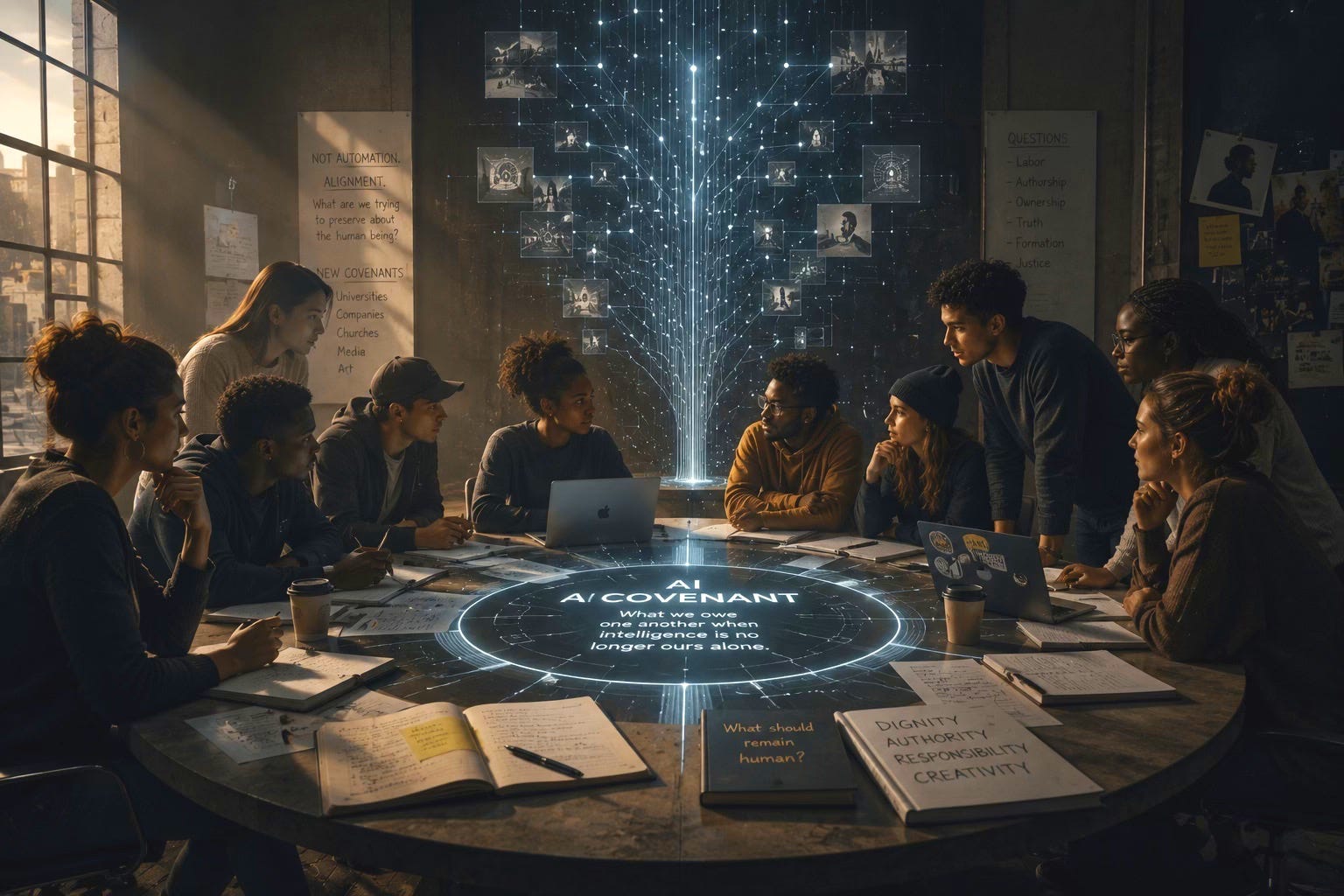
We will need new covenants. Between student and university. Between worker and employer. Between artist and audience. Between pastor and congregation. Between citizen and institution. And before any of them, a covenant with ourselves.
What will we delegate? What will we preserve? What will we keep practicing even when a machine can do it better? What will we remain responsible for? What forms of difficulty will we endure because the difficulty is still forming us? What will we refuse to surrender, not because a machine cannot do it, but because doing it is doing something to us?
Those answers will change. The obligation to ask will not.
And beneath every one of those covenants sits an older question, one that was never actually about artificial intelligence at all.
If what I do is no longer sufficient to tell me who I am, who must I become?
Karmen Michael Smith is an author, public theologian, and founder of The Emerging Human Lab. His work explores identity, AI, human dignity, and what it means to become human in the Post-Notification Era.
Love these insights Karmen. I could only make it through have of it until I had to do the dishes! No worries, enough here for many meals.